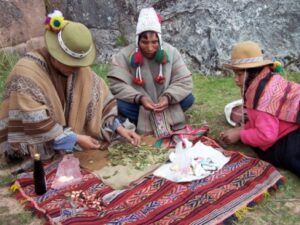
Q’ero Rituals: Living Bridges Between the Human and the Sacred
The Q’eros, known as the last living heirs of the Inka civilization, have preserved rituals that offer healing, spiritual connection, and harmony with nature and the universe. These rituals are not just traditions of the past—they are living expressions of balance, gratitude, and sacred reciprocity with the Earth and the spirits that inhabit the Andean world.
This article offers a deeper understanding of Q’ero rituals—what they mean, how they are performed, and why they remain relevant in today’s spiritual search for connection and purpose.
Who Are the Q’eros?
The Q’ero Nation lives high in the Andes of southern Peru. Their villages are located in remote areas of Cusco’s mountains, where they have maintained their language (Quechua), traditions, and spiritual practices for centuries.
For the Q’eros, spirituality is not a religion—it is a way of life, rooted in the Andean cosmology and based on balance, respect, and the concept of ayni (sacred reciprocity). They believe in a living world, where everything—mountains, rivers, animals, humans, stars—is interconnected through energy and spirit.
The Purpose and Spirit of Q’ero Rituals
Q’ero rituals are spiritual practices designed to restore balance, connect with the forces of nature, and honor the invisible world. Each ritual is a dialogue between the human and the sacred, guided by tradition, intuition, and deep reverence.
These rituals are not performed for show. They are sacred acts of intention, and each element used has symbolic and energetic meaning.
1. The Despacho: Offering to Pachamama
One of the most well-known Q’ero rituals is the Despacho—a ceremonial offering to Mother Earth (Pachamama) and the mountain spirits (Apus). A sacred bundle is prepared with coca leaves, natural elements, sweets, colored yarns, and symbolic items that represent gratitude, prayers, and intentions.
The Despacho is offered in fire, buried in the earth, or left at a sacred site. It is performed to give thanks, ask for blessings, seek healing, or mark transitions in life such as travel, birth, marriage, or change.
2. Mountain Ceremonies with the Apus
The Q’eros recognize sacred mountains, or Apus, as powerful beings who protect and guide. Rituals to the Apus involve prayers, coca offerings, spiritual dialogue, and silence. These ceremonies are usually performed in high-altitude sacred sites and are used to seek strength, vision, or guidance.
3. Energetic Cleansing (J’ucha Qaway)
Spiritual and energetic cleansing is another common ritual. Using tools such as eggs, flowers, stones, smoke, or sacred water, the Q’ero healer removes “hucha” (heavy or stagnant energy) from the body and energy field. The purpose is to purify the person and reestablish inner harmony.
4. Karpay: Energy Transmission and Spiritual Initiation
A Karpay is an energy transmission—a sacred initiation into a lineage, a spiritual path, or a connection with a particular energy or Andean force. It is not a symbolic act but a real energetic transfer, guided by a Q’ero elder. The Karpay awakens spiritual memory, inner power, and responsibility for one’s connection with the sacred.
The Core of the Rituals: Reciprocity and Connection
At the heart of every Q’ero ritual is the principle of ayni—the idea that balance is achieved through mutual exchange. By giving to Pachamama or the Apus, we restore flow. By receiving, we are reminded of our place in the sacred web of life.
Q’ero rituals are not passive events; they require presence, humility, and a deep respect for life in all its forms.
Why Participate in a Q’ero Ritual?
To reconnect with nature through ancient, non-colonial wisdom
To experience healing from an energetic and spiritual perspective
To gain insight into your life path through sacred guidance
To honor transitions, losses, or intentions in a respectful way
To witness and be part of a tradition that honors the Earth as a living being
If You Wish to Join a Ceremony
If you are drawn to participating in a Q’ero ritual, consider the following:
-
Approach with humility and genuine respect
-
Do not treat the ceremony as entertainment or performance
-
Ask permission before taking photos or sharing stories
-
Allow silence and emotion to guide you, rather than intellect
-
Understand that these rituals are part of a worldview—not isolated acts