In a world that often feels disconnected, many of us seek a deeper purpose and connection. Peru, the cradle of the Inca civilization, offers not only stunning landscapes but also a universe of ancestral wisdom. If you’ve ever wondered what makes this place so special, the answer lies in its ancient traditions.
Peruvian Shamanic Traditions: A Journey to the Heart of Ancestral Wisdom
Peruvian shamanic traditions are a holistic system of healing and spiritual knowledge, preserved and passed down for generations. Unlike conventional tourism, which focuses on seeing, Andean shamanism invites you to feel, participate, and heal. Peruvian shamans, known in the Andean tradition as «paqos,» are not just healers; they are living bridges between the physical and spiritual worlds, who facilitate communication with the tutelary beings of nature.
This article will guide you through the pillars of these practices, revealing how a trip to Peru can become a profound personal transformation.
The Andean Worldview: The Soul of the Tradition
To understand Peruvian shamanism, it is essential to know the Andean worldview, its vision of the world. For the Andean people, the universe is divided into three worlds or «Pachas,» all interconnected:
- Hanan Pacha (The Upper World): The celestial realm, home of the stars, the sun (Inti), and the moon (Mama Killa). It represents cosmic energy and higher consciousness.
- Kay Pacha (The Middle World): Our physical world, where humans, nature, and animals coexist. It is the place of learning and experience.
- Ukhu Pacha (The Underworld): The subterranean world, where the ancestors and Pachamama (Mother Earth) dwell. It is the source of vital energy and ancestral wisdom.
Healing is achieved when the shaman helps a person re-establish balance between these three worlds. This process is based on the principle of Ayni, or sacred reciprocity, which teaches that life is a constant exchange of energy and that by giving, you also receive.
Guardians of the Earth: Sacred Deities and Spirits
Andean ceremonies are based on a deep respect for the beings who inhabit the earth and the sky. Two of the most important figures in this tradition are:
Pachamama (Mother Earth): The Goddess of Fertility
Pachamama is the most revered deity in the Andes. She is not just the earth we walk on, but the source of all life. She is considered a mother who nurtures, protects, and sustains humanity. Ceremonies in her honor are acts of gratitude.
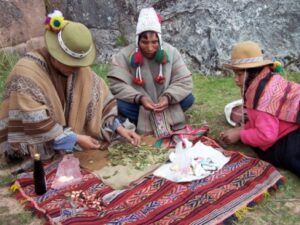
- Practical Example: A common ritual is the Pachamama Offering or «Despacho.» In this ceremony, the shaman guides participants to create a ceremonial «blanket» or package with symbolic offerings, such as coca leaves, grains, candies, flowers, and colored wool. Each element has a meaning, and the offering is made with the intention of thanking Mother Earth for her gifts and asking for harmony and healing.
The Apus (Mountain Spirits): The Millennial Masters
The highest peaks of the Andes are known as Apus, sacred and protective beings. For the communities, these mountains are not just geological formations, but spiritual guardians that provide protection, fertility, and strength.
- Practical Example: On a sacred hike, the shaman can perform a small ritual before ascending. Upon reaching the summit, a moment is taken for silent meditation and, through a symbolic offering (often coca leaves), permission is requested and thanks is given to the Apu for the energy and guidance received.
The Path to Healing: Rituals and Master Plants
Peruvian shamanic traditions use various rituals and tools to facilitate healing and spiritual connection.
- Cleansing Rituals (Limpia): These are purification ceremonies to release stagnant energies, fear, and anxiety. The shaman uses sacred herbs, feathers, and chants to cleanse a person’s aura, restoring their vitality.
- Sacred Plants (Plantas Maestras): Some ceremonies rely on the use of ancestral plants like San Pedro (Wachuma) and Ayahuasca. These medicines, guided by an expert master, facilitate deep introspection, emotional healing, and the expansion of consciousness. It is vital that these ceremonies are performed with an authentic guide in a safe environment and with a clear intention.
Real-Life Case: «I remember arriving with a lot of stress and anxiety. During a ceremony with an Andean master, I felt such a deep connection to the earth and the community that I was able to release an emotional burden I had been carrying for years. The healing I received was not just a moment, but a transformation that continues in my daily life.» – A traveler’s testimonial.
The Role of the Shaman and the Authenticity of the Q'eros
The authenticity of the shamanic experience largely depends on the master’s guidance. The Q’eros nation, known as the last Incan ayllu (community), has preserved their customs and knowledge intact. The Q’eros masters are considered guardians of ancestral wisdom. Their guidance ensures that the experience is not a tourist event, but a genuine encounter with a millennial tradition. Their presence connects you directly to the line of knowledge that has flourished in the Andes for thousands of years.
Conclusion: A Legacy for Your Well-being
Peruvian shamanic traditions offer a unique opportunity to go beyond postcard landscapes. They invite you on a journey of self-discovery and holistic healing, where the body, mind, and spirit are nourished by the wisdom of the earth. Through the connection with Pachamama and the Apus, and with the guidance of an authentic master, you can release trauma, find purpose, and return home feeling renewed and at peace.
This is a path that offers you a genuine connection with one of the most profound cultures in the world.
Call to Action
Are you ready for a journey that will transform your life?
Discover our healing retreats in the Andes and begin your own spiritual pilgrimage.
Connect with an authentic spiritual guide from the Q’eros nation.